On the Ground in Afar: Entering 2026 with Resolve and Hope
7 January 2026
Valerie Browning
On behalf of the entire APDA team
As 2026 begins, APDA is facing the new year with clear eyes and steady resolve. The Afar Region remains under immense pressure—conflict still hangs over communities, markets are disrupted, and families live with deep uncertainty. Yet even in these conditions, APDA and the communities we serve are pushing forward together.
During the first week of January, our team and community members came together to review the year past and plan for what lies ahead. Our focus is simple but vital: reduce vulnerability, strengthen community leadership, and support Afar people to shape their own future.
We extend our heartfelt thanks to you—our donors and partners—whose support through a very difficult 2025 has made this work possible. Being supported is the difference between standing alone and standing strong.
The Reality on the Ground
Afar sits at the heart of a volatile region. Armed forces remain present, access to markets is fragile, and communities are often at the mercy of political forces far beyond their control. Rising fuel costs and economic pressure are deeply affecting families who already live on the edge.
Despite this, APDA continues to work side by side with communities—responding to urgent needs while building long-term solutions.
Our Focus for 2026: Education and Livelihoods
Education remains the greatest need—and the greatest opportunity—in Afar.
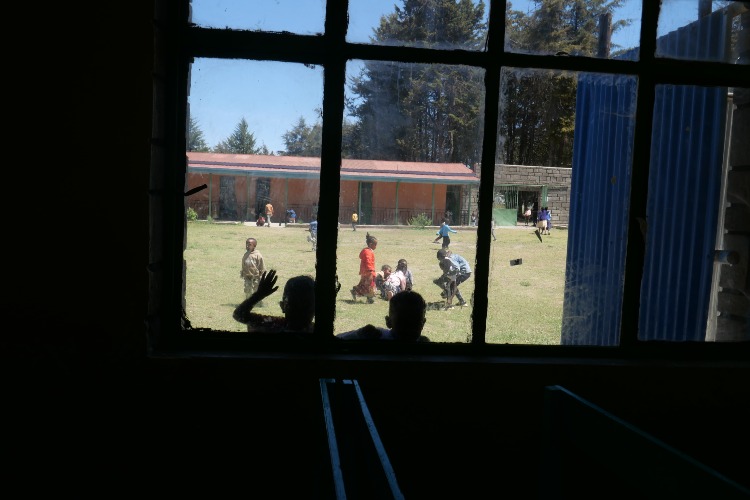
APDA is committed to expanding education in the Afar language, using culturally grounded approaches such as storytelling, song, drama, and local history. With support from volunteer linguists, educators, and local institutions, learning is moving beyond the blackboard to methods that spark creativity and understanding—especially for nomadic families.
Literacy is key to ending harmful practices, improving maternal health, and helping communities navigate a rapidly changing world.
Food insecurity is another urgent challenge. With herds much smaller than in decades past, families face long months with little more than bread to eat. APDA continues working toward practical solutions—veterinary services, animal feed, milk production, and improved market access—so families can nourish their children and prevent malnutrition.
Urgent Concerns Right Now
Earthquakes in Northern Afar
Our urgent concerns As written up in our November 2025 update, the earthquake in Barahale and Konnaba, northern Afar Region continues to shake and quake up to 3 times weekly.
First forcing 54,000 people to abandon their stone houses as 70% of them tumbled down on the evening of October 11th 2025, even yesterday, January 6th, a quake has shattered more houses in Konnaba.
These uprooted people’s main concern is now to re-adapt to houses built from dry palm leaves as they once did a generation ago. The stone houses they repaired and re-built have cracked again.
Displacement Along the Tigray Border
On the Afar western border with Tigray, as of November 11th, 18,111 people still live in displacement, quite frankly, a very ugly site. They actually have no hope of returning to their homeland in Tonsa, Magaale since the Tigray forces still rely on their land as a military base and are infiltrated into their rural habitats. 780 households of the 3,000 that displaced lost every single animal to this emergency: either hyenas ate their livestock or the Tigray army confiscated them for their own benefit. While there is a small stream of water where they are living in 3 displacement camps, there is no grazing for the animals.
Then those who were able to rescue their herds are grazing them in distant hills, the remaining family members in a dry camp waiting for food relief. This is the ugliness. Since as of APDA’s last truck of food in mid - December that they literally shared among themselves, they have no food, our coordinator reporting it is only days before there will be nothing left despite the promise of food assistance from a more indirect system – households registered in early December but still no food.
The immediate solution that APDA can afford is to send them the little food in the store lasting them a few more days and to get animal feed to them that 3 to 5 milking goats per household can return from distant grazing feeding the family.
Rising Human Trafficking
The third current frightening story is that of people trafficking. In recent days, news of young Afar dying in Tripoli, Libya has brought much sadness and extreme anxiety while knowing there are others, even girls in this predicament. The traffickers work in the main towns of the Afar – this, APDA must unveil as the situation is deadly – the extortionists are asking up to 15,000 USD that their relative in Libya can live, that paid, they are still dying. A further payment is needed to board a boat across the Mediterranean.
Here our cry is more a world alert of the desperation that Afar town youth are facing – many them having failed their exams to go into tertiary learning. This horror is repeated through the Region walking people into Djibouti dangerously crossing the Red Sea to Yemen, young Ethiopian girls mainly, all desperate to reach household work in the Arab States.
Restoring Dignity Through Shelter
Houses back to mats…. The architecture of Afar women..
Afar, like many Sahelian nomadic communities construct dome-shaped houses from a frame of bent, thin branches then cover the frame with mats woven from the throngs of dried palm (domma palm). These thousands of years tradition allows them household mobility as well as protecting them from wind, dust and even rain, the inside smoked to water-proof the mats. The actual domma palm only grows in a handful of locations and, in recent times does not reach 25% of the households needed.
What APDA dreams to do is to facilitate community – access widely to the raw material so that women such as the earthquake and the Magaale displaced communities can make the houses they want as well as marketing them and again, rather than seeing plastic sheeting from humanitarian support covering the dome or scraps of torn clothing, women can re-gain the house – pride.
This needs the purchase of truck – loads of dry palm leaves from the actual three sites where the domma palm is indigenous.
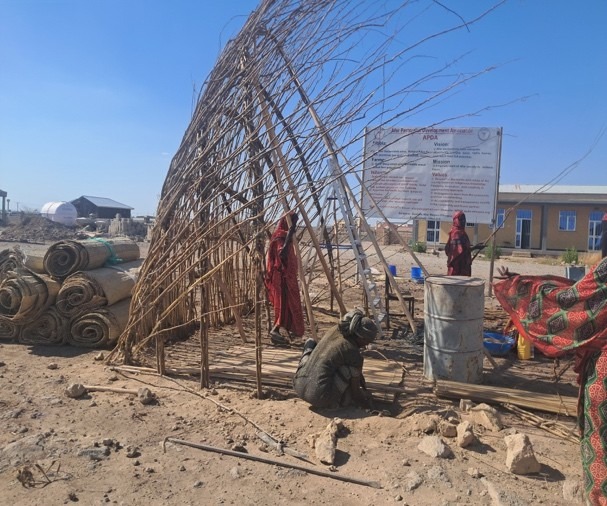
^ Local women helping APDA to construct a demo ‘daboyta’/ traditional house in the organization field compound, Samara: rolled mats behind to cover the frame, so far half the dome. Ladder and barrel added ‘office’ equipment. The organization is at speed now to welcome 50 guests in 2 weeks coming from Amhara Region, Sudan, Kenya, Burkina Faso, Bangladesh – all in the name of community driven development. In the background is the board describing who APDA is.
Related Posts