Localization,
is it possible??
is it possible??
14 May 2026
By Valerie Browning
As defined by Google, Localization of humanitarian aid is the practice of shifting power and decision-making to local actors, such as local organizations and communities, to increase the effectiveness, sustainability, and accountability of aid responses. This shift is achieved through more direct funding, equitable partnerships, and giving local actors a central role in coordination and leadership, with the goal of creating a more locally owned and driven response.
First perhaps it should be said why is the shift necessary? – it can be understood when asking why communities in need are not using the resources they have and, despite every potential, remain dependent unable to cope with the various shocks. It was WFP over 10 years ago that stated there is enough food in the world to feed all but distribution does not allow for those most affected to access it. Another Google statistic: In 2025, an estimated 673 million people worldwide faced hunger in 2024, representing about 8.2% of the global population, a slight decrease from previous years. However, progress is uneven, with hunger rising in Africa and western Asia, while improving in parts of Asia and South America. In addition, nearly 2.3 billion people experienced moderate or severe food insecurity, and 2.6 billion people could not afford a healthy diet in 2024. I live where the FAO map says that 10 to 25% under 3 years are malnourished in Ethiopia, actually living in the Afar Region of the country where the highest child growth stunting at 43% is, almost double that of the world average stunting rate of 23.2% (UNICEF figure) - all 2025 figures. The African continent in any statistics rates dominant in parameters of hunger, disease and inadequate household assets.
Fate of those in need is determined far from them, in another context, with motives away from direct benefit of enabling improved living going forward. Historically the humanitarian world has been perceived that people/ communities in need are helpless. This taken further allows any possible form of ‘aid’ to be directed at them, they the needy expected to be grateful.
While the World Humanitarian Summit of 2016 colloquially named the ‘the Grand Bargain’ vowed to correct the balance, assuring 25% of all resources were delivered through ‘local NGOs’ to the needy having discerned that in history, humanitarian aid had not in fact served to reduce poverty. While almost no gains have been made on this gallant proclamation, perhaps the sticking point is the ‘shifting of power and decision – making to local actors.’ On one side is the relinquishing of power, on the other side is whether those who then take up the baton are able and discerning of what the community actually need/ want. The full sentence reads ‘shifting of power and decision – making to local actors and communities.’ In most natural and manmade disasters, the communities are somehow remote: distant, shaded by the disaster and not available to write up the needs’ assessment and then their proposal. They do not comfortably come to where communication can reach out to resources, certainly not in hotel meeting halls or the like and the ‘network’ is not for them accessible. Someone else is telling their story. Yet their very assets they depend on are lost, damaged or at best at risk of loss. In this they are powerless leading them tragically to dependency. Even their way of life is endangered to change under the weight of endured shocks.
However, if the whole picture is knitted together and ‘need’ is seen as momentary, necessarily leading to recovery and on into/ return to development/ resilience and self-sufficiency and indeed the human right to dignity, then those targeted should wear the shoes. In any situation those assumed as ‘local’ could be geographically culturally distant but still qualify since they are in country. All too often status, intellectual ability and what is assumed necessary for an organization to exist actually does put them remote from the people they claim to serve. Then in this case, the power is shifting from an organization foreign to the country to an organization from within. This scenario is all too likely to repeat the problem: the difference is the community is subject to a different master with local rules and regulations coming from a perceptive external to theirs. The community, while it is their future that is endangered, still have no say and cannot see the assistance as the road to recovery and the sustainability we all write about. The project ends, that is it. In the first place, assistance did not come from their premise it came through the local NGO who mirrors the demands and needs of the donor (international NGO or bilateral). While they may well have been photographed in their misery they were not asked as to the ‘what and how’ of their rescue. There is nothing for them to grasp as their contribution and ownership in the process, not even allowing them to identify with what is happening. Their innate knowledge and reasoning on how to avoid the shock into the future is not part of the plan, what they lost must necessarily be replaced with what they get given – and they must sign for it.
Somewhere here are the reasons why the ‘south’ especially here in Africa does not move forward to embrace normal human rights for themselves – despite the resources, the innate knowledge and yearning to do so. Even many of the continent are not permitted to realize from where the problem came and take the ownership leading to a solution that is feasible in their hands. All comes packaged and ready-made even through the hands of local NGOs who have become recipients to back-donors since one of the criteria of the donor’s call for proposals is that local NGOs are implementers in the process.
More and more I am realizing that the organization I work with, as well me as an individual have no right to spell out the future for another. I need to be where I can totally listen to the community, they disclosing the dimensions of the issue and they declaring what is needed to solve the problem: from them foremost, from their government – they must actually formulate the solution and drive it, mapping progress and defining how to articulate achievement. To get onto that sovereign ‘listening mat’ in front of them, I need to be accepted culturally as relating to them so that I can receive their precious and intimate information. My role is simply the messenger carrying their voice to the world beyond and, if they agree on their behalf soliciting assistance which again, they control not me.
For a solution to the incumbent crisis, the power equation has to be fully with them. If this was the norm of humanitarian action the gains the world speaks of by 2030 (17 SDGs) may have been possible including ‘a world without hunger’. The overriding challenge was that these 17 goals were devised away from the people they aim to effect, our challenge then is to translate them into activated meaning for the communities we serve.
This idea that the drivers of change and the change-makers are the community themselves can dispel any myths about ‘climate change’ being the greatest obstacle within their own territory, human beings knowing what is needed in terms of adaptation – a process in action for centuries but now needing acceleration to meet the devastating climate effects. The community then need to the space to articulate, a channel they trust to project their voice and a realization shared with whom they trust of the way forward to mitigation.
In conclusion, localization IS the reversing of the now oppressive situation where the community is waiting. In the end, the organization I work with needs to resolve to become obsolete being that it is a community-based local NGO, the objective we hold to is that ‘Afar pastoralists have adequate opportunity to enjoy basic human rights and reach their full potential’. Then that can be said of the entire humanitarian system as it now exists: communities worldwide need to determine their destiny, shed their vulnerability and be capable of managing any and all threats while producing adequately for their safety and wellbeing.
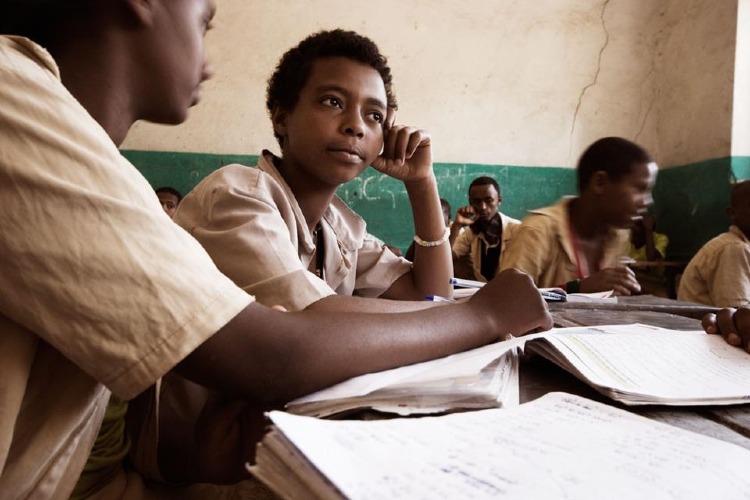
Perhaps one of the least spoken of sectors of human need and development is education – this should be the defining motor for the community to move forward into self-sufficiency giving them the ability to communicate and make decisions beyond the restrictions of traditional practices that may not apply today. Learning at all levels appropriate to the given community is vital to achieving self-reliance.
What has not been discussed here is financial resource that of course establishes the power – position in a relationship. Again, taken the right way around managed accountably, it belongs to the targeted community. The community perception of wealth is wider than that of a bank account, salaries and facilitation. It is the building of a future and the future generation including the environment they inhabit in a protective way. As the system is, accountability is blocked by the systems to record it. Given community governance of funding, any form of humanitarian assistance would in fact be cheaper and more sustainable. Here is where another radical change needs to take place. It is in the tangled pursuit of insatiable gain that the ‘developed world’ has polluted planet Earth and left no space for the ones they the ‘haves’ did leave behind.
APDA’s experiences in working toward community controlling the agenda
In the community:
- From the beginning, APDA’s advantage was that clan elders decided on the formation of the organization setting the trend to community perspective from the beginning.
- Then to deliver social services to a community moving for grazing and water, APDA trained from the respective community, the community leaders deciding on who could fulfill the role. Thus, today APDA has 167 community mobile health workers, 274 women extension workers, 182 community teachers and 22 environment or livelihood scouts serving and living among the community they grew up with. These people all have team leaders or coordinators that link to the sector level experts in the Samara field office. They all give monthly reports and their ‘xaagu’ (daily information) reaches the field office as a continual flow. They are the change agents in any one community.
- A community development committee in each kebele/ community area leads these community development workers that they are diligent at gaining coverage; are supporting the most vulnerable people and that any physical support is fairly distributed. Clan leaders, religious leaders, leading women and leading youth make up the committee – they communicate through the team leader or as directly as they choose.
- Since the inception, the organization has been all Afar and to date, anyone interacting with the community from APDA is Afar. By this means, traditional law is a mechanism to govern and direct being that most activities take place in geographic settings where government services do not reach. The Afar language is used in written form leading to community ownership of the discussion and agenda.
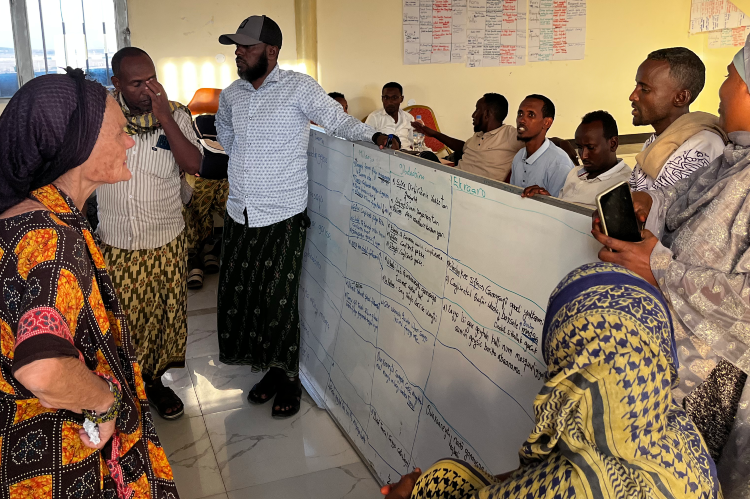
- Quarterly review and planning meetings of the entire program from 42 districts that the program implements in – this allows an interaction of discussion and learning as to where and how the objective of APDA’s implementation has reached allowing for adjustment to strategies. The interaction with the community is analyzed in this meeting.
Meeting emergency needs and mitigation:
- For the community to analyze the need and subsequently the solution, APDA uses the community disaster risk reduction method
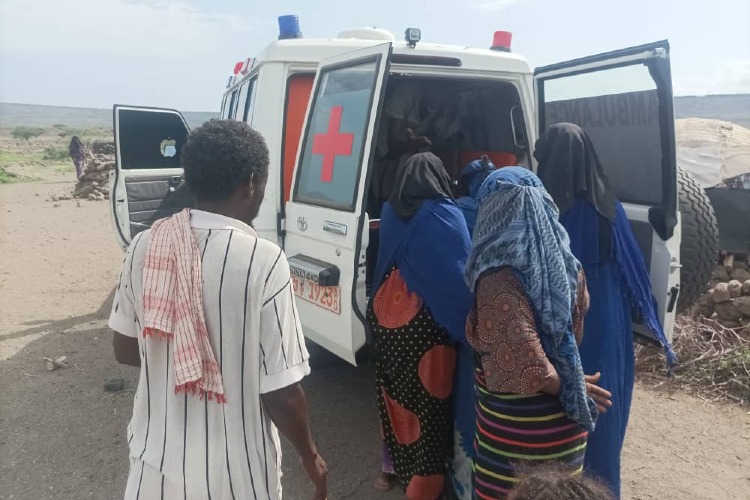
- As far as possible, APDA tries to respond to human need in shock in the shortest period of time, dispatching emergency health team to quell diseases outbreaks; providing veterinary medicines; providing concentrated animal feed; supplementary food for malnourished and anemic pregnant and lactating mothers. In this circumstance, it is decided with the community if they can pay the cost price of the item or they are literally without household funds. This then allows for the reservation of their dignity that they are not simply getting hand-outs.
- APDA is able to support with concentrated animal feed having a production plant locally operating through the organization social enterprise. Through this, the organization is encouraging the community to feed milking and breeding animals to avoid the catastrophe of drought and have milk in the house all year round. While this is a change in community perception and behavior, clan leaders are directing and the news of communities who acted in this way is spreading.
- Community – based cooperatives with MoU with APDA are assisting in getting food cheaper into the communities the cooperative using APDA’s trucks to move supplies, thereby reducing costs.
At the project level:
- APDA now has 2 years’ experience through the Netherlands Enterprise Agency wherein they deliberate the community are the project designers, implementers and monitors we, APDA are a conduit for their funding. This then does precisely what localization aims for in putting all power into the community hand, them utilizing the budget. Taking this model, APDA is able to similarly relegate power to the community in other such livelihood and environment restoration projects. This builds community leadership and to date has no real constraints.
- At every opportunity, learning Afar literacy and numeracy is built into the project as the means of taking decisions especially among women at the home level and also the higher community level.